
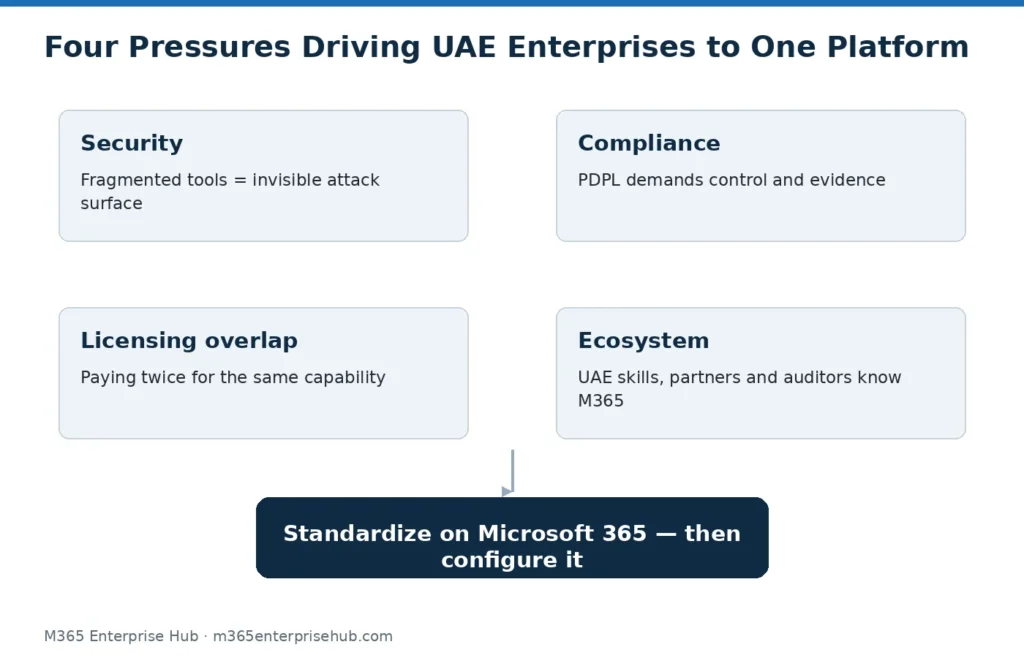
Ask UAE IT leaders why they consolidated on Microsoft 365 and the answers cluster around four practical pressures: security exposure from fragmented tools, compliance obligations under the UAE’s data protection regime, the cost of running overlapping products, and the need for a platform that local partners, auditors and new hires already know. This post walks through each mechanism — not as marketing, but as the actual decision logic we see in enterprise assessments.
1. Fragmentation Is a Security Problem Before It’s a Cost Problem
The typical pre-consolidation estate: email on one platform, files on another, chat on a third, video calls on a fourth, plus whatever individual departments adopted on a credit card. Every additional platform is a separate identity store, a separate attack surface, and a separate place data leaks from — and none of them see each other.
Consolidating on Microsoft 365 doesn’t remove threats; it makes them visible in one place. One identity (Entra ID) with one MFA policy, one Conditional Access rulebook, one audit log, and security tooling (Defender) that correlates a phishing email with the endpoint it touched and the account it targeted. For a security team, defending one integrated platform is a fundamentally more tractable job than defending six disconnected ones.
2. The Compliance Case: PDPL Made Data Location and Control a Board Question
The UAE Personal Data Protection Law (Federal Decree-Law No. 45 of 2021) — alongside the DIFC and ADGM regimes for entities in those jurisdictions — obliges organizations to know what personal data they hold, control who accesses it, and evidence both. That’s close to impossible when data lives across disconnected consumer-grade tools.
Microsoft 365’s compliance layer (Purview) exists precisely for this: retention policies, sensitivity labels, data loss prevention and eDiscovery applied across email, files, and Teams messages from one console. Standardizing doesn’t make an organization compliant by itself — configuration does — but it makes compliance configurable, which fragmentation never is.
3. The Licensing Math: Overlap Is the Silent Budget Leak
Most organizations that consolidate discover they were paying separately for capabilities their Microsoft licensing already included — a third-party video tool duplicating Teams, standalone storage duplicating OneDrive and SharePoint, a separate MFA product duplicating Entra ID features. The consolidation case is rarely “Microsoft is cheaper per seat”; it’s “we are paying twice for half of this stack.”
The honest caveat: Microsoft licensing is complex, and unmanaged tenants leak money in the other direction — unused licenses, wrong tiers, E5 features paid for and never deployed. Consolidation needs license governance to deliver its savings, which is part of what a Microsoft 365 services engagement covers.
4. The Ecosystem Effect: Skills, Partners and Auditors Already Speak It
A platform decision is also a hiring and support decision. In the UAE market, Microsoft 365 administration skills are the most available collaboration-platform skills to hire; certified local partners exist at every scale; and external auditors arrive already knowing how to assess a Microsoft 365 environment. Standardizing on a niche stack means every future hire, audit and integration carries a translation cost. Standardizing on the dominant platform means the ecosystem works in your favour — including when you need a local provider rather than an overseas helpdesk.
What Standardization Actually Involves
For an enterprise with an existing estate, the path usually runs: migration of email and files to the tenant, identity consolidation into Entra ID, security baseline configuration, then decommissioning of the overlapping tools — the step organizations most often skip, and the step where the savings actually live. Migration itself is a solved problem with the right planning; our cloud migration services page covers phases and pitfalls.
The failure mode to avoid: buying the licenses, moving the mailboxes, and stopping. A tenant left at defaults delivers a fraction of the platform’s value and none of its compliance posture. Standardization is a governance project wearing a migration project’s clothes.
Frequently Asked Questions
Is Microsoft 365 suitable for regulated UAE industries?
Yes — banking, government and healthcare organizations operate on it, with configuration matched to their regulators’ requirements. Data residency and retention must be deliberately configured and documented per workload; suitability is a configuration outcome, not a default.
Does standardizing mean removing every other tool?
No. Specialist tools with no Microsoft equivalent stay. The target is eliminating overlap — tools duplicating what the licensed platform already does.
How long does consolidation take?
It depends on estate size and data volume; phased migrations measured in months are typical for enterprises. We don’t publish generic timelines because they mislead — a scoping assessment produces a real one.
What’s the first step?
An entitlement and estate review: what you already license, what you separately pay for that overlaps it, and where your data currently lives. That review usually funds the rest of the project.