
Microsoft enterprise solutions are the business-grade product families Microsoft sells to organizations: Microsoft 365 for productivity and collaboration, Azure for cloud infrastructure, Dynamics 365 for business operations, the Defender and Purview families for security and compliance, and Power Platform for automation. Most UAE enterprises run a combination — the practical question is not “which is best?” but “which problem does each one solve, and which do we actually need?”
This guide maps common business problems to the right Microsoft product family, so you can walk into a licensing or vendor conversation knowing what you’re buying and why.
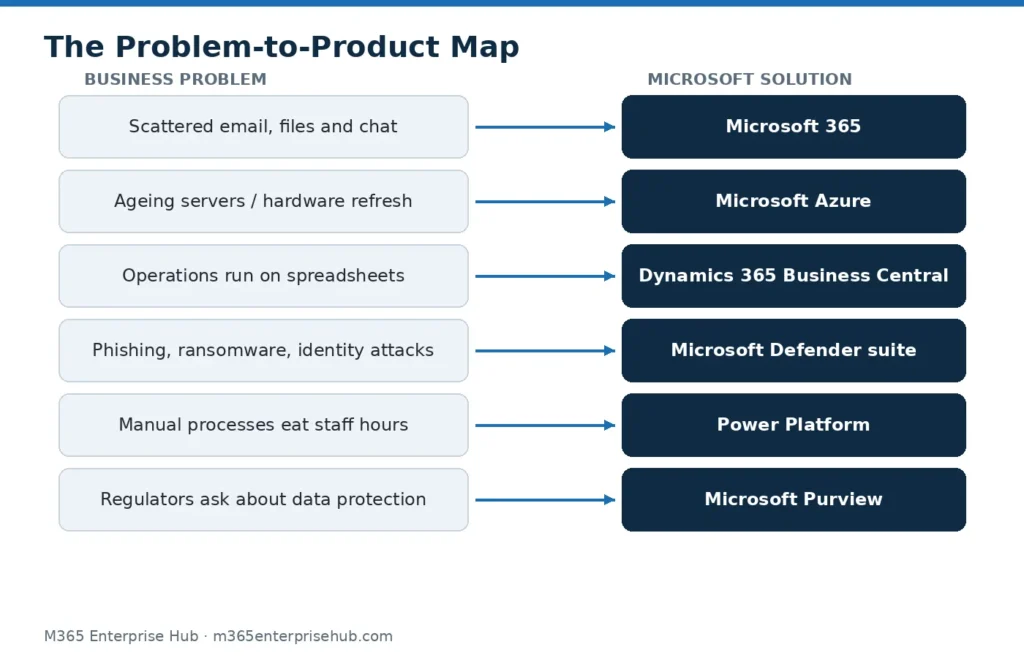
The Problem-to-Product Map
| Business problem | Microsoft solution | What it includes |
|---|---|---|
| Teams can’t collaborate; email, files and chat are scattered | Microsoft 365 | Exchange Online, Teams, SharePoint, OneDrive, Office apps |
| Servers are ageing; hardware refresh is due | Azure cloud services | Virtual machines, storage, networking, Azure Virtual Desktop |
| Finance and operations run on spreadsheets or a legacy ERP | Dynamics 365 Business Central | Finance, inventory, sales, purchasing in one SaaS system |
| Phishing, ransomware and identity attacks | Microsoft Defender suite | Defender for Office 365, Endpoint, Identity; XDR correlation |
| Manual processes eat staff hours | Power Platform | Power Automate, Power Apps, Power BI |
| Regulators ask how data is protected and retained | Microsoft Purview (within Microsoft 365 E3/E5) | Retention, sensitivity labels, DLP, eDiscovery |
Microsoft 365: The Productivity Layer
Microsoft 365 is where most organizations start because it replaces the most visible pain: email that lives on an on-premises Exchange server, files on a shared drive nobody can access remotely, and meetings spread across third-party tools.
For an enterprise, the meaningful decisions sit above the apps themselves: which license tier (Business plans cap at 300 users; Enterprise E3/E5 add compliance and security depth), how identity is managed, and how Teams and SharePoint are governed so collaboration doesn’t turn into sprawl. A Microsoft 365 service provider earns its fee in those decisions, not in mailbox creation.
Azure: The Infrastructure Layer
Azure answers a different question: where do our servers, applications and workloads live? UAE organizations typically arrive at Azure through one of three doors — a data-centre exit or hardware refresh, a disaster-recovery requirement, or a new application that needs infrastructure fast.
Azure is consumed, not installed, which is why cost governance matters as much as deployment. An unmanaged subscription accumulates idle VMs and oversized resources quietly. That’s the case for managed Azure services: someone accountable for right-sizing, security posture and monthly cost review.
Dynamics 365: The Operations Layer
Where Microsoft 365 is about people working together, Dynamics 365 is about the business itself — quotes, orders, inventory, invoicing, financial close. For mid-sized UAE companies the relevant product is usually Business Central, delivered as SaaS, with UAE VAT handled through localization. It replaces the point where the spreadsheet-based process breaks: usually when finance can no longer reconcile what sales committed to.
Defender and Purview: The Security and Compliance Layer
Security is the layer UAE boards now ask about directly, and it spans the other three. The Defender family covers email threats, endpoint attacks and identity compromise; Microsoft Sentinel adds SIEM capability on top for organizations that need central monitoring. Purview handles the compliance half — retention, data loss prevention, and the audit trail that matters under the UAE Personal Data Protection Law (Federal Decree-Law No. 45 of 2021).
The common enterprise mistake is owning these tools through an E5 license and never configuring them. Licensing is not deployment.
How to Choose: Three Questions
1. What breaks first if nothing changes? Fund that layer first. A collaboration problem is a Microsoft 365 project; an ageing server room is an Azure project; a finance team drowning in spreadsheets is a Business Central project.
2. What do you already own? Many UAE enterprises hold E3 or E5 licenses with security and compliance features switched off. An assessment of current entitlements often uncovers paid-for capability before any new purchase is needed.
3. Who operates it after go-live? Every layer above needs ongoing administration — identity reviews, security monitoring, cost governance. Decide whether that’s an internal team, a managed services partner, or both, before you deploy.
Frequently Asked Questions
What counts as a “Microsoft enterprise solution”?
The business-grade product families: Microsoft 365 (Enterprise plans), Azure, Dynamics 365, the Defender/Purview security and compliance stack, and Power Platform. Consumer and small-business editions of the same products are licensed and supported differently.
Do we need all of them?
No. Most organizations phase in layers as problems demand: productivity first, then security hardening, then infrastructure or operations. Buying everything at once usually produces shelfware.
What’s the difference between Microsoft 365 and Office 365?
Office 365 refers to the productivity apps and services; Microsoft 365 bundles those with Windows enterprise licensing and security/device management. Microsoft’s current enterprise plans are sold under the Microsoft 365 name.
Can these run in a UAE-compliant way?
Yes, but compliance is configuration, not default. Data residency, retention and DLP need to be set up deliberately — particularly for organizations subject to the UAE PDPL or sector regulators such as DIFC and ADGM.